Southeast Asia spans from the equator to the Tropic of Cancer, which means weather varies enormously across the region. There's no single "best time" — the ideal month for Bali is the worst month for parts of Vietnam.
This guide breaks down monthly weather, monsoon seasons, and the best travel windows for every major SE Asian destination so you can plan the perfect trip.
🌏 Quick Answer
| When Are You Going? | Best Destinations | Avoid |
|---|---|---|
| Jan–Feb | Thailand, Vietnam, Cambodia, Laos, Myanmar, Philippines | Bali (rainy) |
| Mar–Apr | Vietnam, Bali (dry season starts), Philippines | Chiang Mai (burning season) |
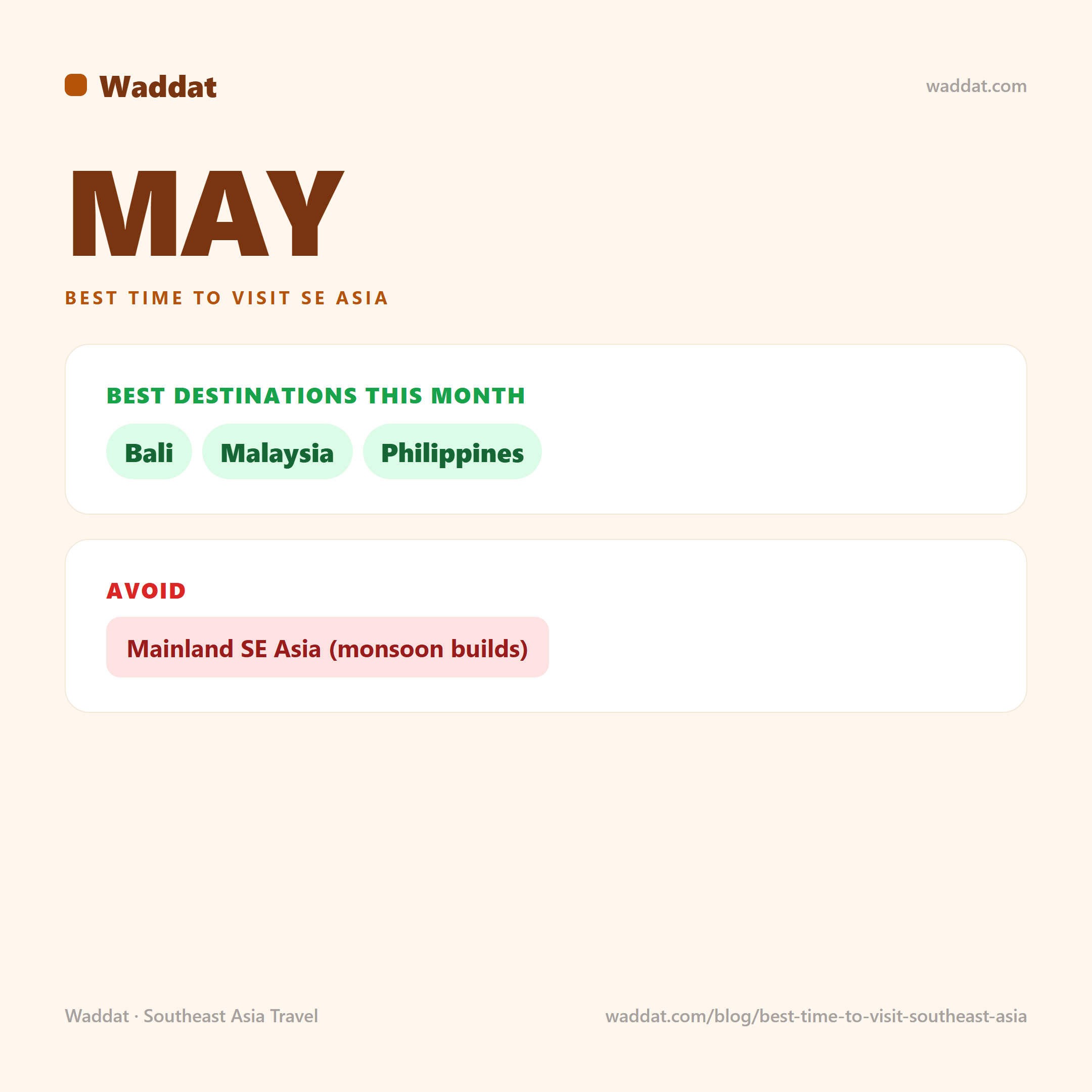
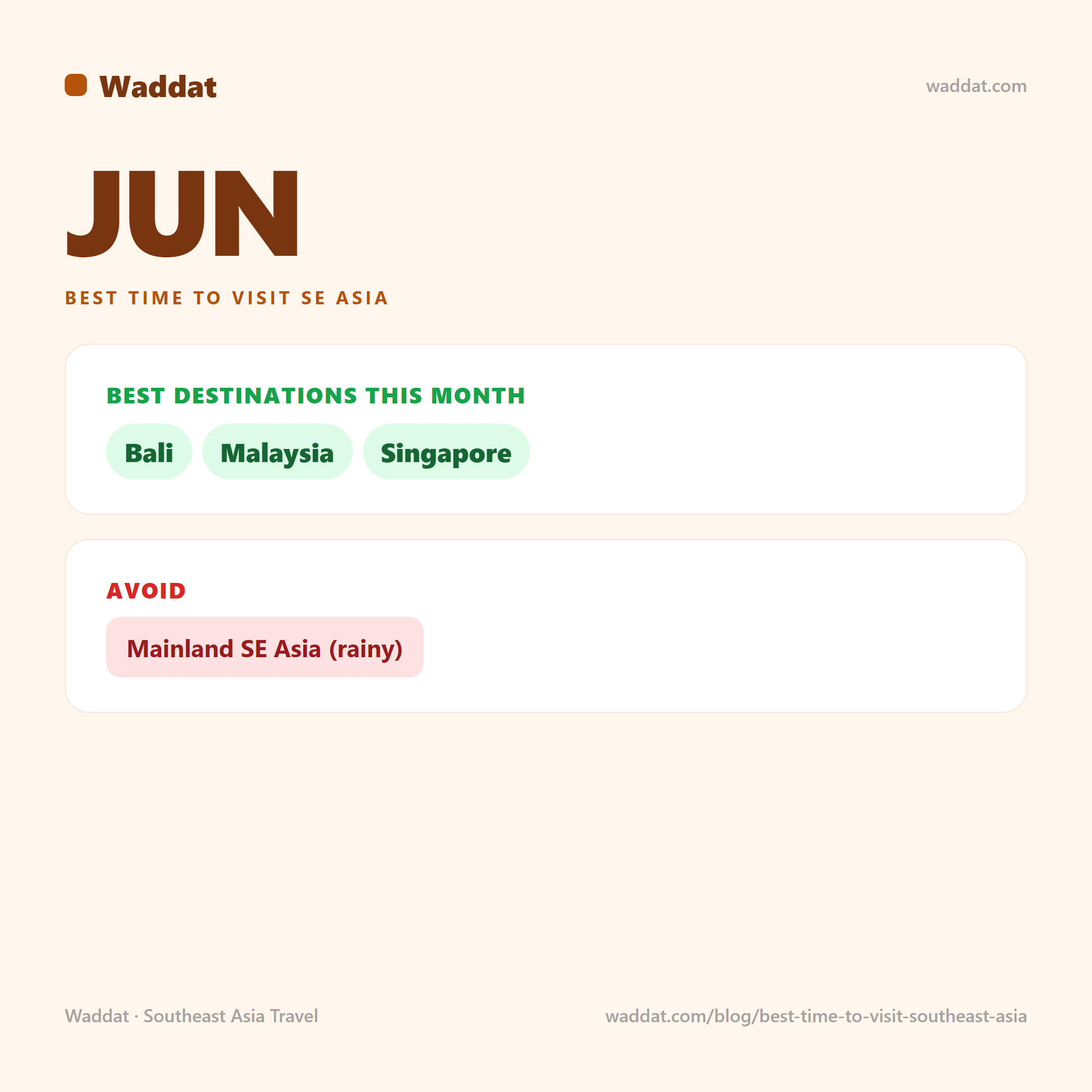
| May–Jun | Bali, Lombok, Malaysia | Most of mainland SE Asia (rainy) |
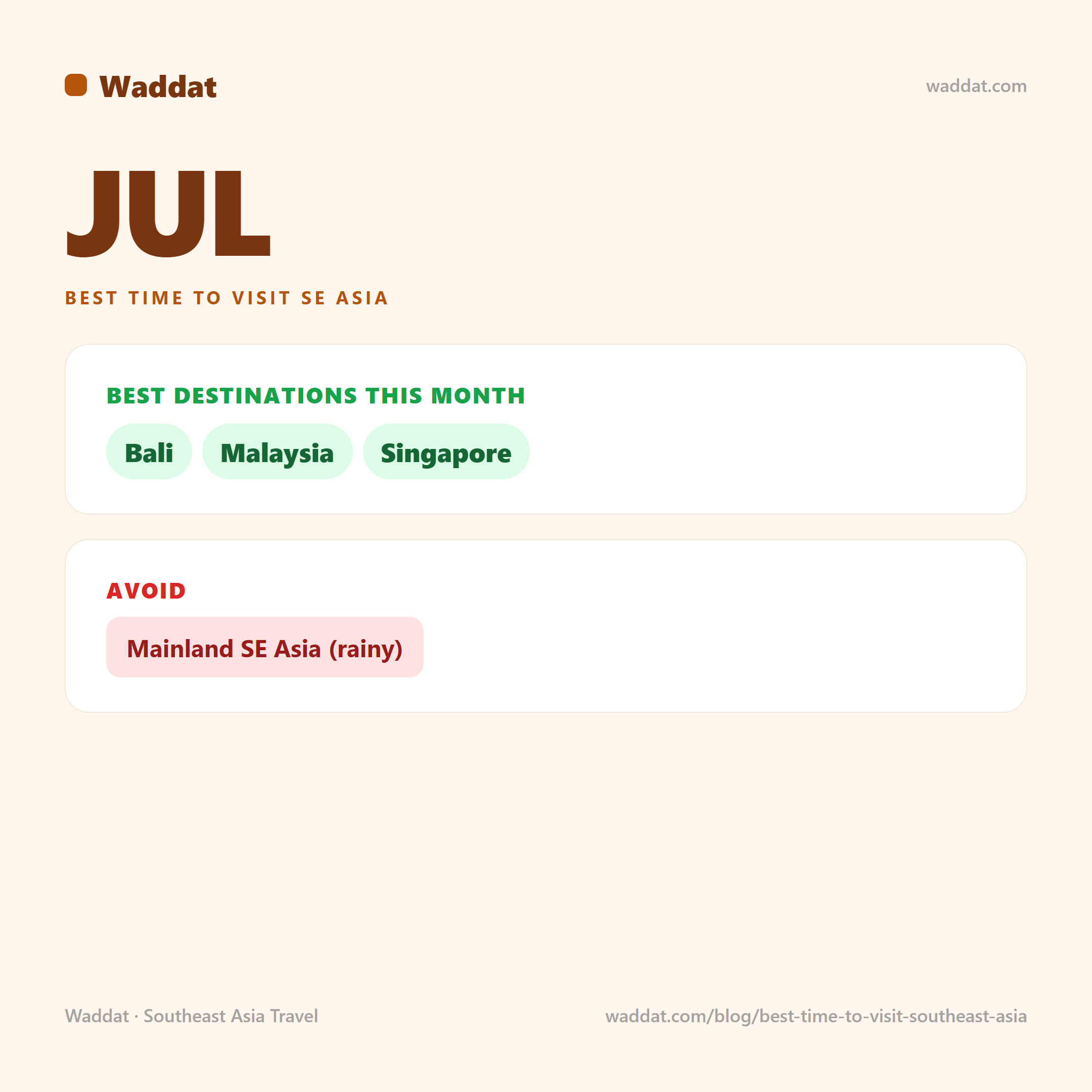
| Jul–Aug | Bali, Malaysia, Singapore, Koh Samui | Hanoi/HCMC (rainy) |
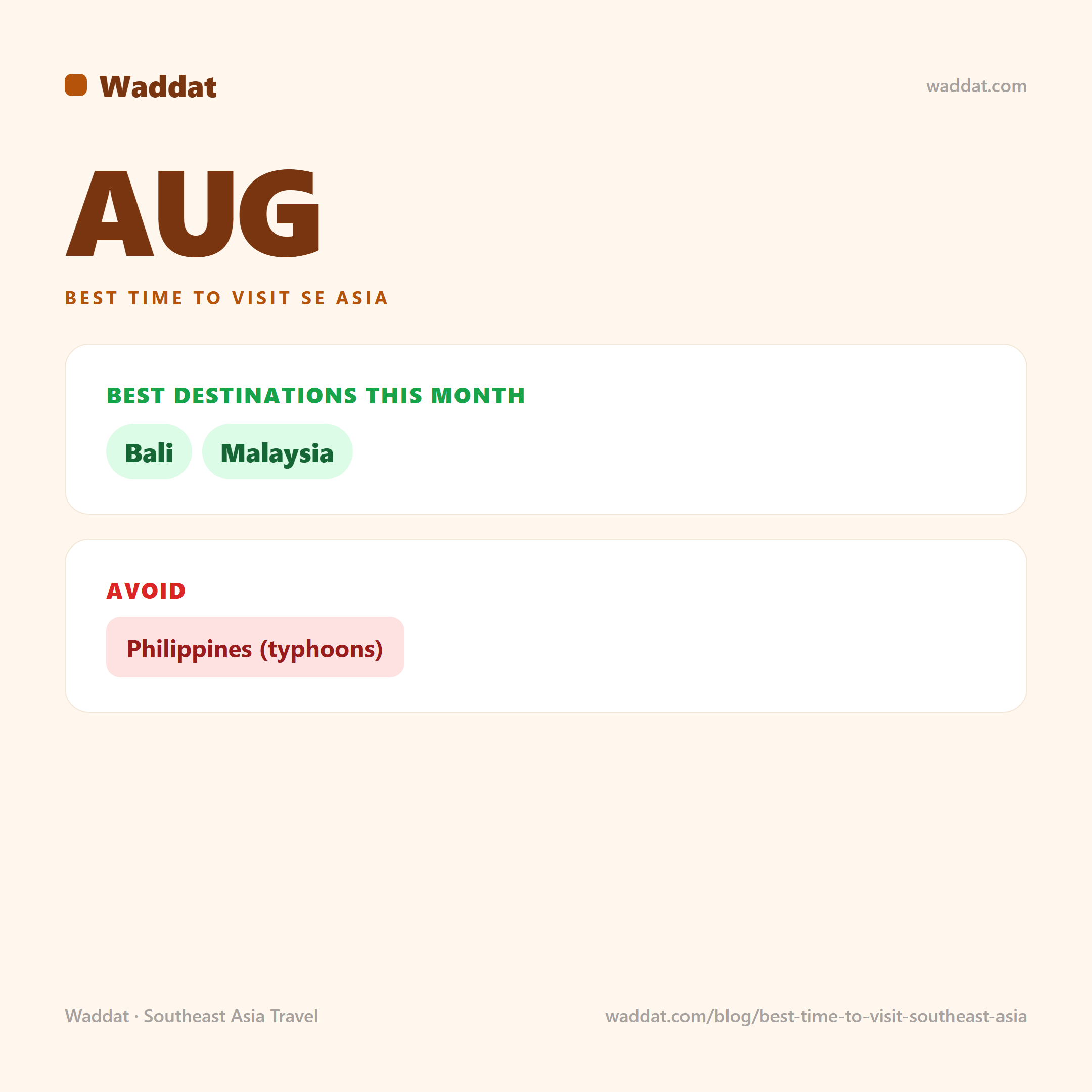
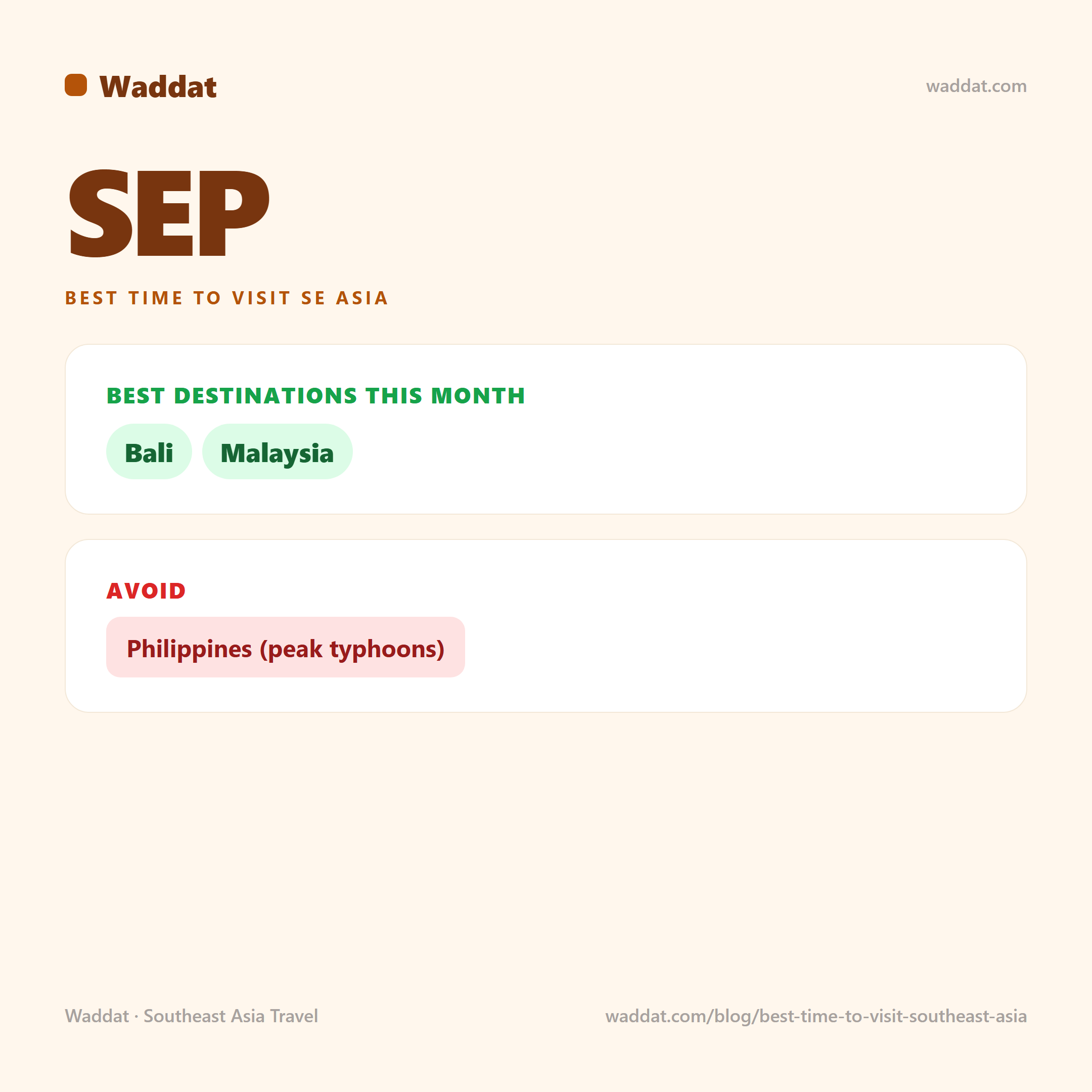
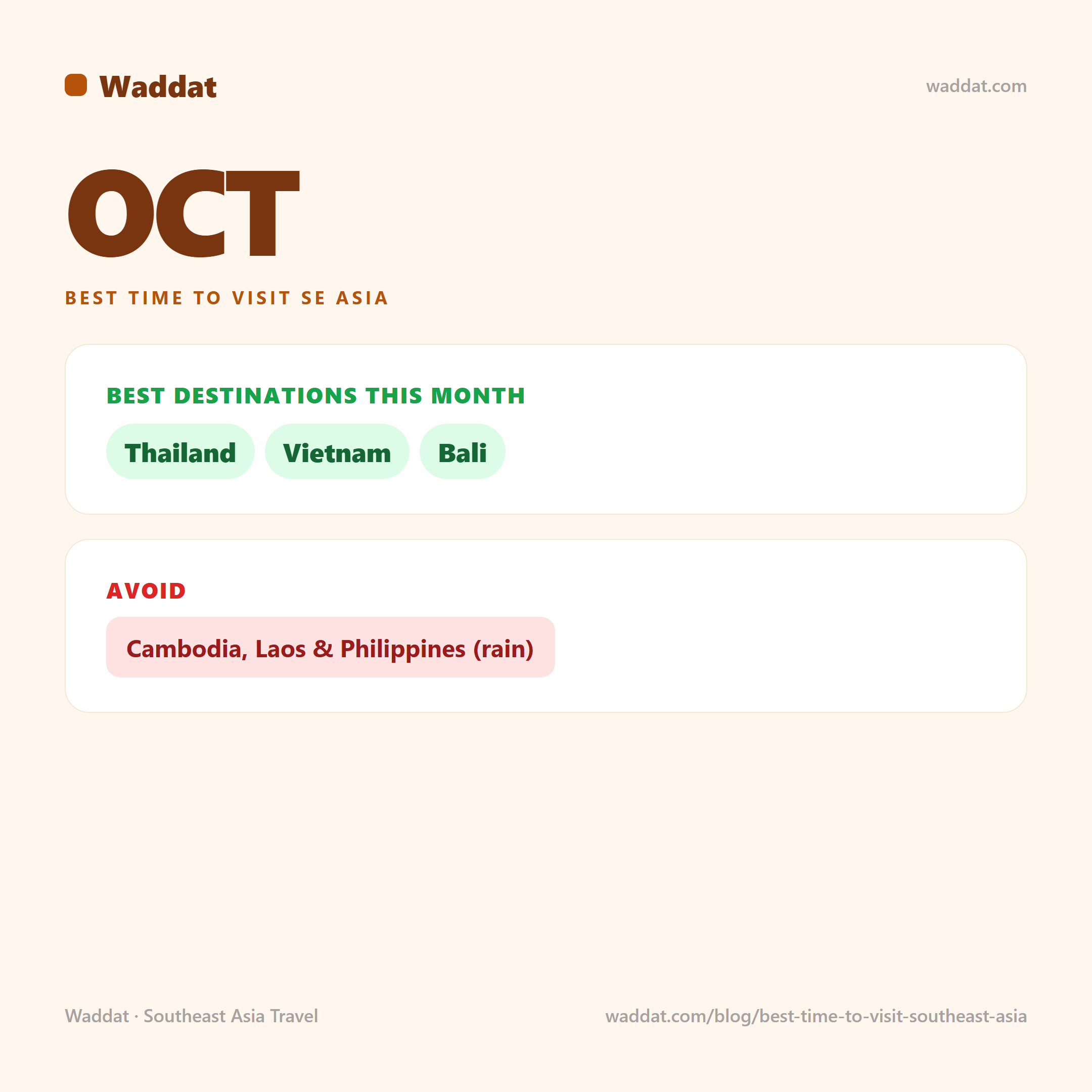
| Sep–Oct | Bali, Vietnam (shoulder), Cambodia (shoulder) | Philippines (typhoons) |
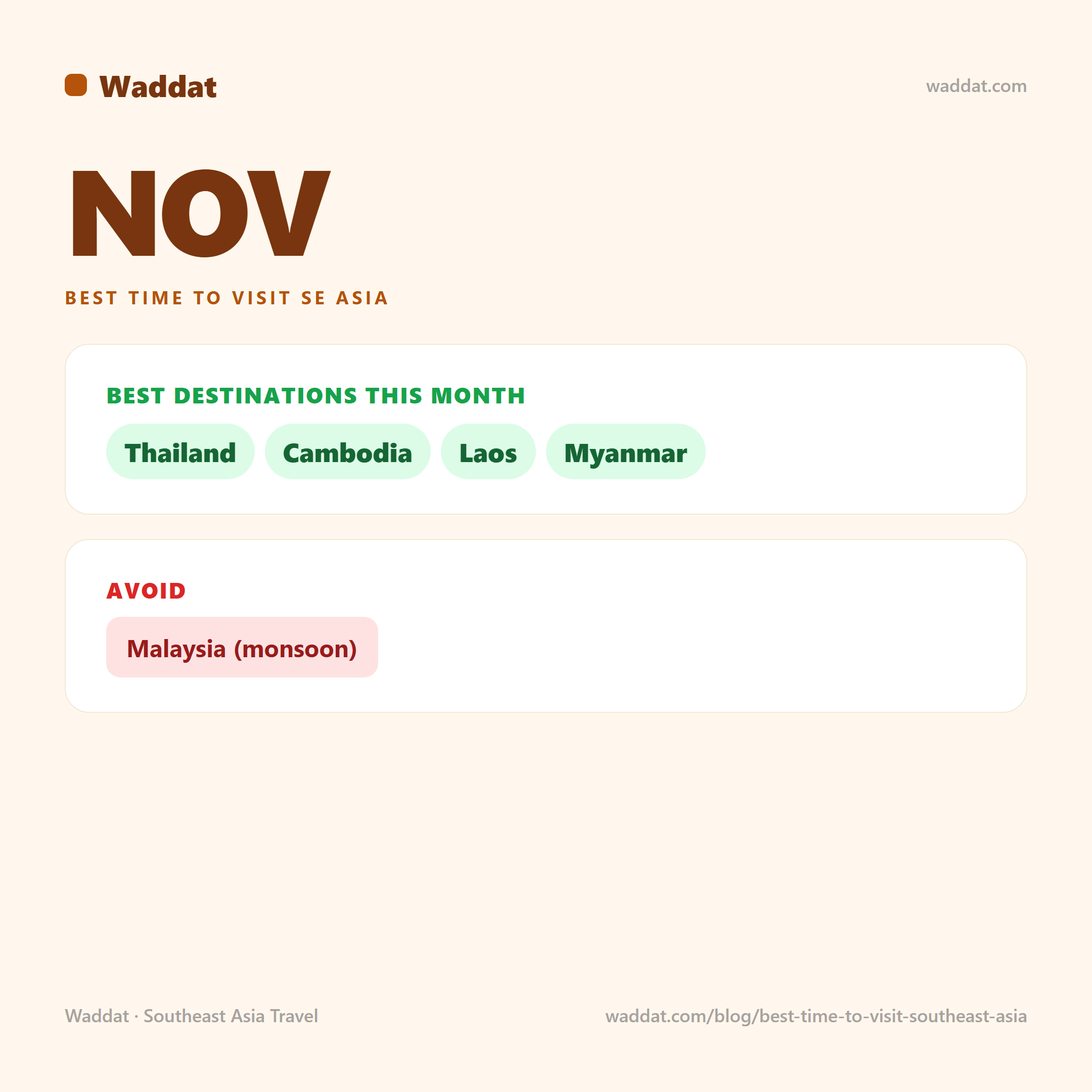
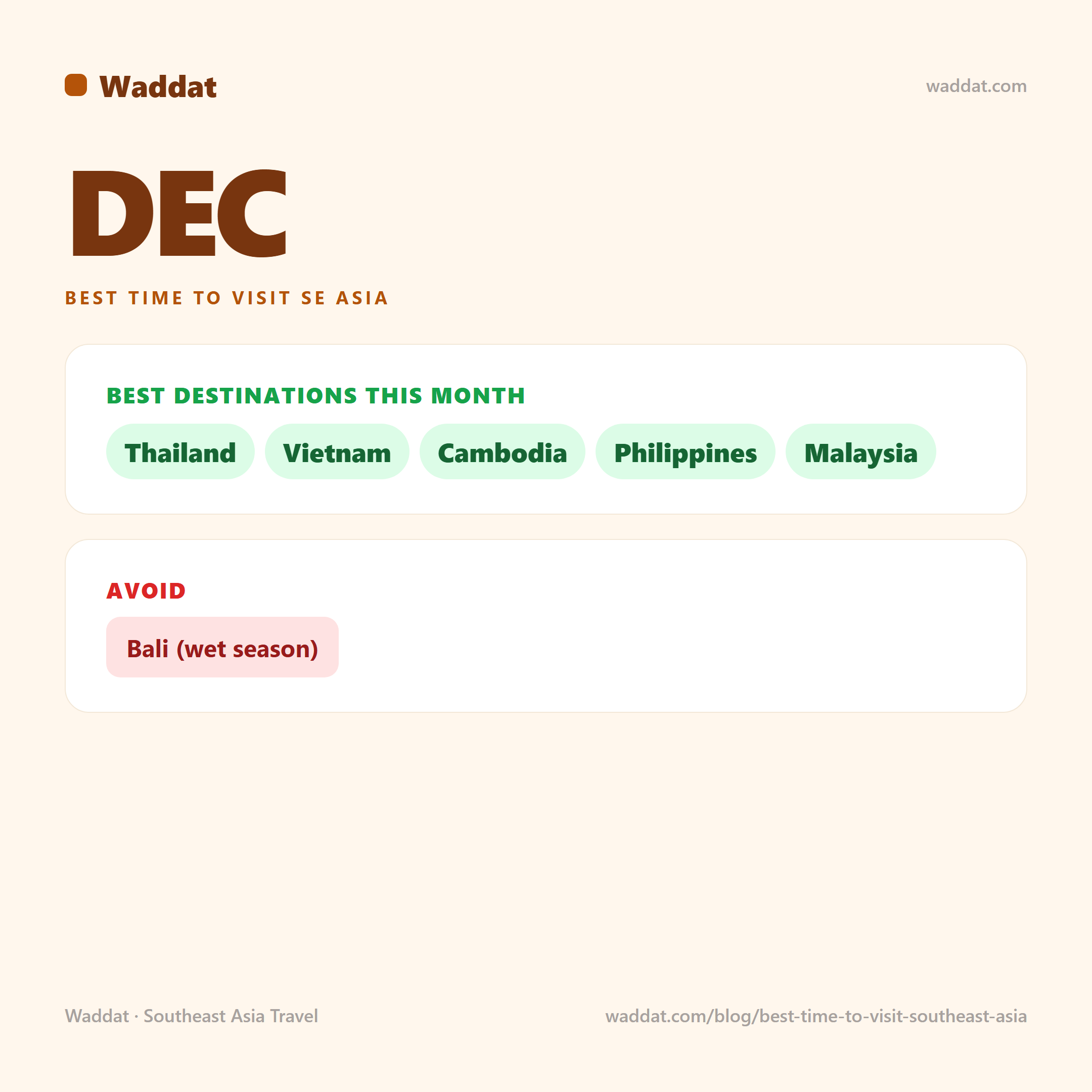
| Nov–Dec | Thailand, Vietnam, Cambodia, Laos, Myanmar | Bali (rainy) |
Best overall months: January–February for mainland SE Asia · April–October for Bali & Indonesia
📑 Table of Contents
- Weather Overview
- Thailand
- Vietnam
- Cambodia
- Laos
- Indonesia (Bali)
- Malaysia
- Philippines
- Myanmar
- Singapore
- Ultimate Travel Calendar
- Festival Calendar 2026
- Multi-Country Itineraries by Month
- Packing Tips
- FAQs
SE Asia Weather Overview
Southeast Asia has three main climate zones:
1. Tropical Monsoon Climate (Mainland SE Asia)
Countries: Thailand, Cambodia, Laos, Vietnam, Myanmar
Three seasons:
- Cool/Dry (Nov–Feb): Best weather. Low humidity, minimal rain, comfortable temperatures (25–32°C).
- Hot (Mar–May): Scorching heat (35–40°C). Great for beach destinations, tough for cities.
- Rainy/Monsoon (Jun–Oct): Heavy rain, high humidity. But rain often comes in short bursts, not all-day downpours. Cheaper prices and fewer crowds.
2. Equatorial Climate (Maritime SE Asia)
Countries: Indonesia, Malaysia, Singapore, Philippines
Two seasons:
- Dry (Apr–Oct for Bali; Dec–Feb for East Malaysia): Less rain, more sunshine.
- Wet (Nov–Mar for Bali; May–Nov for West Malaysia): Rain and humidity. Still travelable.
3. Tropical Savanna (Parts of Vietnam, Philippines)
Distinct wet and dry seasons with less predictable timing.
Best Time to Visit by Country
Thailand — Best: November to February
Monthly Weather Summary
| Month | Temp (°C) | Temp (°F) | Rain (mm) | Humidity | Season |
|---|---|---|---|---|---|
| Jan | 27°C/21°C | 81/70°F | 10mm | 65% | Cool & Dry ⭐ |
| Feb | 29°C/23°C | 84/73°F | 20mm | 60% | Cool & Dry ⭐ |
| Mar | 32°C/25°C | 90/77°F | 30mm | 60% | Hot ⭐ |
| Apr | 34°C/26°C | 93/79°F | 65mm | 65% | Hot |
| May | 33°C/26°C | 91/79°F | 220mm | 72% | Hot & Wet |
| Jun | 32°C/25°C | 90/77°F | 150mm | 70% | Rainy |
| Jul | 31°C/25°C | 88/77°F | 155mm | 72% | Rainy |
| Aug | 31°C/25°C | 88/77°F | 200mm | 75% | Rainy |
| Sep | 30°C/24°C | 86/75°F | 345mm | 80% | Rainy |
| Oct | 30°C/24°C | 86/75°F | 240mm | 78% | Rainy |
| Nov | 30°C/23°C | 86/73°F | 55mm | 70% | Cool & Dry ⭐ |
| Dec | 28°C/21°C | 82/70°F | 10mm | 65% | Cool & Dry ⭐ |
Best Months: ⭐ November – February
Cool temperatures (21–29°C), minimal rain, low humidity. This is peak season — book early and expect higher prices.
Shoulder Season: March – April, October
March–April are hot (34–35°C) but dry. Great for beach holidays if you can handle the heat. October is transitional — rain is tapering off and crowds are thin.
Low Season: May – September
The monsoon season brings heavy rain, especially September. But here's the secret: rain usually falls in afternoon downpours, not all day. Mornings and evenings are often sunny. Hotels are 30–50% cheaper.
Regional Notes
- Gulf islands (Koh Samui, Koh Phangan): Rainy season is different — October–December. Best time: January–September.
- Andaman coast (Phuket, Krabi): Rainy season is May–October. Best time: November–April.
- Chiang Mai: Burning season (Feb–Apr) causes poor air quality. Visit November–January or July–September.
Read more: Bangkok Travel Guide | Thailand Budget Travel Guide | Best Hotels in Phuket | Chiang Mai Hostels | Koh Samui Luxury Resorts | Koh Samui Destination Guide
Vietnam — Best: Depends on Region
Vietnam is unique — its 1,650km length means the north, center, and south have completely different weather patterns. You need to plan by region.
Monthly Weather by Region
| Month | Hanoi (North) | Da Nang (Center) | HCMC (South) |
|---|---|---|---|
| Jan | 17°C, dry ⭐ | 22°C, some rain | 27°C, dry ⭐ |
| Feb | 18°C, dry ⭐ | 23°C, dry | 28°C, dry ⭐ |
| Mar | 21°C, some rain | 24°C, dry | 29°C, dry |
| Apr | 25°C, some rain | 27°C, dry | 30°C, dry ⭐ |
| May | 29°C, rain starts | 29°C, hot & dry | 29°C, rain starts |
| Jun | 31°C, rainy | 30°C, hot & dry | 28°C, rainy |
| Jul | 30°C, rainy | 29°C, some rain | 28°C, rainy |
| Aug | 29°C, rainy | 28°C, rainy season | 28°C, rainy |
| Sep | 28°C, rainy | 27°C, rainy peak | 27°C, rainy |
| Oct | 25°C, dry starts | 26°C, rainy | 27°C, rainy |
| Nov | 22°C, cool & dry ⭐ | 24°C, rainy | 27°C, dry starts |
| Dec | 18°C, cool & dry ⭐ | 22°C, cool & dry | 26°C, dry ⭐ |
North (Hanoi, Sapa, Ha Long Bay)
- Best: October – December, March – April
- Avoid: June – September (heavy rain, flooding risk)
- Note: December – February can be cool (15–20°C) and overcast. Sapa can drop to near freezing.
Central (Da Nang, Hoi An, Hue)
- Best: February – May (dry, warm)
- Avoid: September – November (typhoon season — serious flooding risk)
- Note: Hoi An flooding is common in October–November.
South (Ho Chi Minh City, Mekong Delta, Phu Quoc)
- Best: December – April (dry, warm)
- Avoid: May – November (wet season, but short bursts)
- Note: Phu Quoc is best November–April (dry) and wettest July–September.
Read more: 5-Day Vietnam Itinerary | Hanoi Travel Guide | Da Nang Travel Guide | Ha Long Bay Cruise Guide | Best Street Food in Hanoi | Da Nang Destination Guide
Cambodia — Best: November to March
Monthly Weather Summary
| Month | Temp (°C) | Rain (mm) | Humidity | Season |
|---|---|---|---|---|
| Jan | 31°C/22°C | 5mm | 60% | Cool & Dry ⭐ |
| Feb | 33°C/23°C | 5mm | 55% | Cool & Dry ⭐ |
| Mar | 35°C/24°C | 25mm | 55% | Hot ⭐ |
| Apr | 36°C/25°C | 70mm | 65% | Hot |
| May | 34°C/25°C | 140mm | 72% | Hot & Wet |
| Jun | 32°C/25°C | 155mm | 75% | Rainy |
| Jul | 31°C/25°C | 170mm | 78% | Rainy |
| Aug | 30°C/25°C | 175mm | 80% | Rainy |
| Sep | 30°C/24°C | 225mm | 82% | Rainy |
| Oct | 30°C/24°C | 260mm | 80% | Rainy |
| Nov | 30°C/23°C | 130mm | 75% | Transition ⭐ |
| Dec | 30°C/22°C | 15mm | 65% | Cool & Dry ⭐ |
Best Months: ⭐ November – March
Dry, warm, and relatively cool. December–January are the most comfortable. Angkor Wat at sunrise in December is magical.
Low Season: June – October
Heavy rain, especially September–October. Roads around Siem Reap can flood. But Angkor Wat looks incredible with moats full of water, and you'll have the temples nearly to yourself.
Read more: Cambodia Budget Travel Guide | Siem Reap Travel Guide | Phnom Penh Travel Guide
Laos — Best: November to February
Similar weather pattern to northern Thailand and Cambodia.
Monthly Weather Summary
| Month | Temp (°C) | Rain (mm) | Season |
|---|---|---|---|
| Jan | 28°C/14°C | 5mm | Cool & Dry ⭐ |
| Feb | 30°C/16°C | 15mm | Cool & Dry ⭐ |
| Mar | 33°C/19°C | 30mm | Hot & Dry |
| Apr | 35°C/22°C | 100mm | Hot |
| May | 33°C/23°C | 175mm | Rainy starts |
| Jun | 31°C/24°C | 200mm | Rainy |
| Jul | 30°C/24°C | 230mm | Rainy |
| Aug | 29°C/23°C | 260mm | Rainy |
| Sep | 29°C/22°C | 210mm | Rainy |
| Oct | 29°C/20°C | 100mm | Transition |
| Nov | 28°C/17°C | 15mm | Cool & Dry ⭐ |
| Dec | 27°C/14°C | 5mm | Cool & Dry ⭐ |
Best Months: ⭐ November – February
Cool mornings and evenings (14–16°C), warm days (27–30°C), very little rain. Perfect for exploring Luang Prabang and Vang Vieng.
Low Season: June – September
Heavy rain, especially in the mountains. Some roads become impassable. The Mekong can rise dramatically. But Kuang Si Falls is at its most spectacular.
Read more: Laos Budget Travel Guide | Luang Prabang Travel Guide | Vang Vieng Travel Guide
Indonesia (Bali) — Best: April to October
Bali's dry season is the opposite of mainland SE Asia — making it perfect for combining a trip.
Monthly Weather Summary (Bali)
| Month | Temp (°C) | Rain (mm) | Humidity | Season |
|---|---|---|---|---|
| Jan | 30°C/24°C | 340mm | 80% | Wet |
| Feb | 30°C/24°C | 270mm | 80% | Wet |
| Mar | 30°C/23°C | 220mm | 78% | Wet |
| Apr | 30°C/23°C | 90mm | 72% | Transition ⭐ |
| May | 29°C/22°C | 75mm | 70% | Dry ⭐ |
| Jun | 28°C/22°C | 45mm | 65% | Dry ⭐ |
| Jul | 27°C/21°C | 40mm | 62% | Dry ⭐ |
| Aug | 28°C/21°C | 25mm | 60% | Dry ⭐ |
| Sep | 28°C/21°C | 50mm | 62% | Dry ⭐ |
| Oct | 29°C/22°C | 90mm | 68% | Transition ⭐ |
| Nov | 30°C/23°C | 170mm | 72% | Wet |
| Dec | 30°C/23°C | 280mm | 78% | Wet |
Best Months: ⭐ April – October
Dry, sunny, and less humid. July–August are the coolest and driest months — also peak season with the highest prices. April–May and September–October offer the best value.
Low Season: November – March
The wet season brings heavy rain and high humidity. January–February are the wettest. But don't rule it out entirely — rain usually falls in the afternoon, and prices drop 30–50%.
Regional Notes
- Ubud: Cooler and rainier than the coast year-round due to elevation.
- Nusa Penida: Rough seas July–August make boat crossings difficult.
- Lombok/Gili Islands: Drier than Bali, with a similar seasonal pattern.
Read more: Bali Travel Guide | Bali Budget Travel Guide | 7-Day Bali Itinerary | Canggu vs Seminyak | Best Villas in Ubud | Lombok Travel Guide
Malaysia — Best: December to February (West), March to October (East)
Malaysia's east and west coasts have opposite monsoon seasons.
Monthly Weather Summary (Kuala Lumpur)
| Month | Temp (°C) | Rain (mm) | Season |
|---|---|---|---|
| Jan | 32°C/23°C | 170mm | NE Monsoon |
| Feb | 33°C/23°C | 150mm | Transition ⭐ |
| Mar | 33°C/23°C | 200mm | Transition |
| Apr | 33°C/24°C | 250mm | Transition |
| May | 33°C/24°C | 200mm | Dry |
| Jun | 32°C/24°C | 130mm | Dry ⭐ |
| Jul | 32°C/23°C | 150mm | Dry ⭐ |
| Aug | 32°C/23°C | 175mm | Dry ⭐ |
| Sep | 32°C/23°C | 195mm | SW Monsoon |
| Oct | 32°C/23°C | 260mm | SW Monsoon |
| Nov | 31°C/23°C | 280mm | NE Monsoon |
| Dec | 31°C/23°C | 240mm | NE Monsoon |
West Malaysia (Kuala Lumpur, Penang, Langkawi)
- Best: December – February, June – August
- Note: KL is hot and humid year-round. Rain comes in short tropical downpours regardless of season.
East Malaysia (Borneo — Sabah, Sarawak)
- Best: March – October
- Avoid: November – February (northeast monsoon, rough seas, flooding)
Regional Notes
- Penang: Best December–February. Avoid October (wettest month).
- Langkawi: Best November–April. Avoid July–August (rough seas).
- Cameron Highlands: Pleasant year-round (18–25°C).
Read more: Kuala Lumpur Travel Guide | Langkawi Travel Guide | Best Hotels in Penang | Kota Kinabalu Travel Guide
Philippines — Best: December to May
Monthly Weather Summary (Manila)
| Month | Temp (°C) | Rain (mm) | Season |
|---|---|---|---|
| Jan | 30°C/21°C | 15mm | Dry ⭐ |
| Feb | 31°C/22°C | 10mm | Dry ⭐ |
| Mar | 33°C/23°C | 15mm | Dry ⭐ |
| Apr | 34°C/24°C | 30mm | Dry ⭐ |
| May | 33°C/25°C | 120mm | Hot & Wet |
| Jun | 32°C/25°C | 280mm | Rainy |
| Jul | 30°C/24°C | 350mm | Rainy |
| Aug | 30°C/24°C | 420mm | Rainy/Typhoon |
| Sep | 30°C/24°C | 330mm | Rainy/Typhoon |
| Oct | 30°C/24°C | 210mm | Rainy |
| Nov | 30°C/23°C | 150mm | Transition |
| Dec | 29°C/22°C | 80mm | Cool & Dry ⭐ |
Best Months: ⭐ December – May
The dry season brings sunshine and calm seas. January–March are the most comfortable. Boracay, Palawan, and Siargao are all at their best.
Low Season: June – November
Typhoon season is the main concern — the Philippines gets hit by 15–20 typhoons per year. Palawan is partially sheltered and receives less rain. Siargao's surf season (September–November) attracts wave riders despite the rain.
Regional Notes
- Palawan (El Nido, Coron): Best November–May. Rainy June–September but less severe than Luzon.
- Boracay: Best December–May. White Beach is stunning in the dry season.
- Siargao: Best for surfing September–November (rainy season, but that's when the waves are best).
Read more: Palawan Travel Guide | 5-Day Palawan Itinerary | El Nido vs Coron | Davao Travel Guide
Myanmar — Best: November to February
Monthly Weather Summary (Yangon)
| Month | Temp (°C) | Rain (mm) | Season |
|---|---|---|---|
| Jan | 32°C/18°C | 5mm | Cool & Dry ⭐ |
| Feb | 34°C/19°C | 5mm | Cool & Dry ⭐ |
| Mar | 36°C/22°C | 10mm | Hot |
| Apr | 38°C/24°C | 40mm | Hot |
| May | 33°C/25°C | 300mm | Rainy starts |
| Jun | 30°C/24°C | 450mm | Rainy |
| Jul | 29°C/24°C | 500mm | Rainy |
| Aug | 28°C/24°C | 550mm | Rainy |
| Sep | 29°C/24°C | 400mm | Rainy |
| Oct | 31°C/23°C | 200mm | Transition |
| Nov | 32°C/21°C | 60mm | Cool & Dry ⭐ |
| Dec | 32°C/18°C | 10mm | Cool & Dry ⭐ |
Best Months: ⭐ November – February
Cool, dry, and pleasant. Perfect for exploring Bagan's temples and Yangon's markets. December–January are peak season.
Low Season: May – October
Extremely heavy rain, especially July–August. Some areas become inaccessible. Travel is possible but challenging.
Read more: Bagan Temple Guide
Singapore — Year-Round Destination
Monthly Weather Summary
| Month | Temp (°C) | Rain (mm) | Season |
|---|---|---|---|
| Jan | 30°C/24°C | 235mm | NE Monsoon |
| Feb | 31°C/24°C | 160mm | Transition ⭐ |
| Mar | 32°C/24°C | 185mm | Transition |
| Apr | 32°C/25°C | 180mm | Transition |
| May | 31°C/25°C | 170mm | Slightly drier |
| Jun | 31°C/25°C | 160mm | Slightly drier ⭐ |
| Jul | 31°C/25°C | 155mm | Slightly drier ⭐ |
| Aug | 31°C/25°C | 175mm | Transition |
| Sep | 30°C/24°C | 170mm | Transition |
| Oct | 31°C/24°C | 195mm | SW Monsoon |
| Nov | 30°C/24°C | 255mm | NE Monsoon |
| Dec | 30°C/24°C | 270mm | NE Monsoon |
Best Months: ⭐ February, June – July
These are the driest months, but honestly, Singapore is a year-round destination. Rain comes in short, heavy bursts that pass quickly. The city is designed for it — covered walkways and MRT connections mean you rarely get wet.
Low Season: November – January
The northeast monsoon brings the most rain, but it rarely disrupts travel. Hotel prices may be slightly lower.
Read more: Best Hawker Centres in Singapore | Singapore on a Budget
The Ultimate SE Asia Travel Calendar
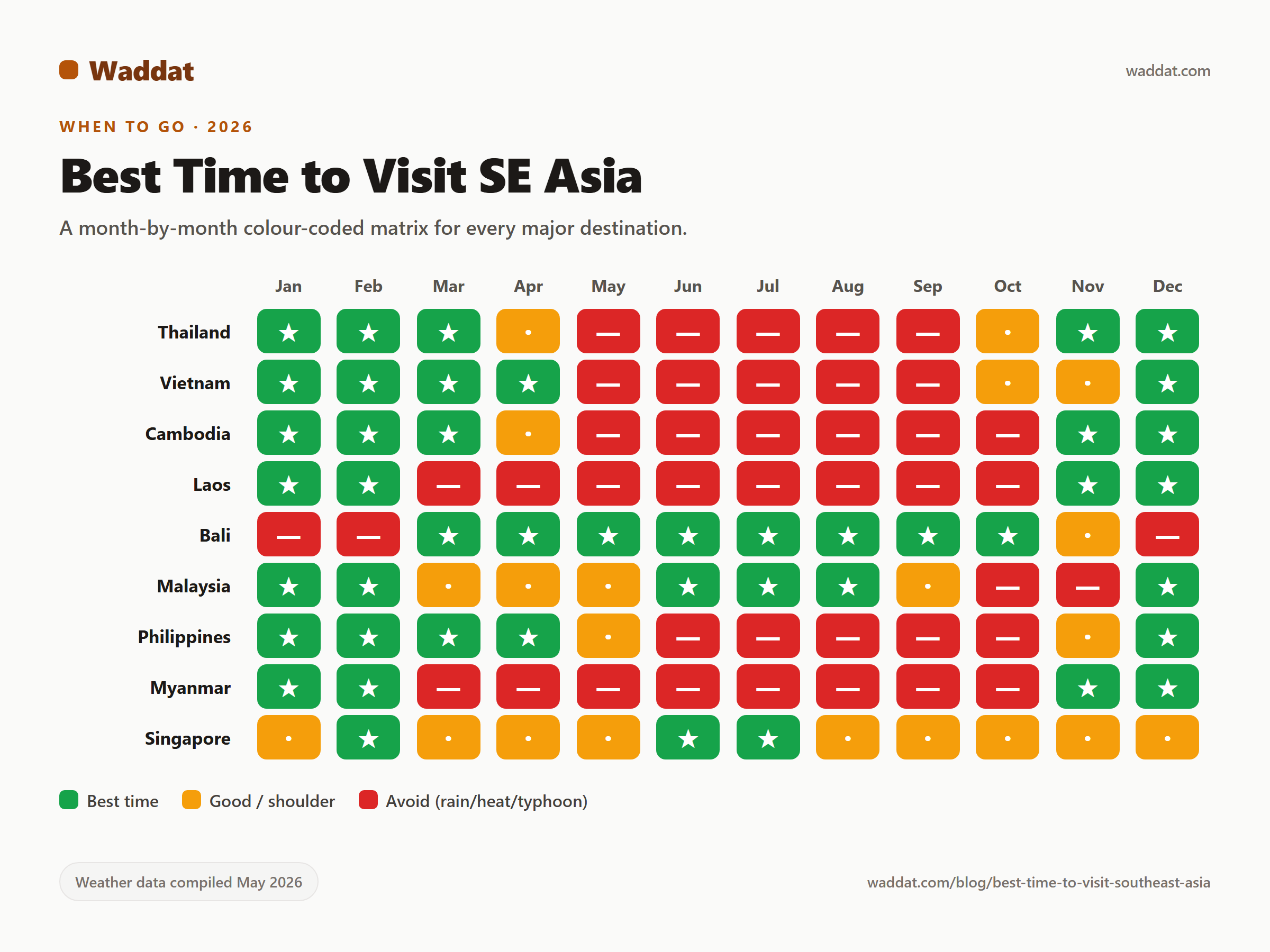
This at-a-glance calendar shows the best months to visit each destination:
| Month | Thailand | Vietnam | Cambodia | Laos | Bali | Malaysia | Philippines | Myanmar | Singapore |
|---|---|---|---|---|---|---|---|---|---|
| Jan | ⭐ | ⭐ | ⭐ | ⭐ | — | ⭐ | ⭐ | ⭐ | ✅ |
| Feb | ⭐ | ⭐ | ⭐ | ⭐ | — | ⭐ | ⭐ | ⭐ | ⭐ |
| Mar | ⭐ | ⭐ | ⭐ | — | ⭐ | ✅ | ⭐ | — | ✅ |
| Apr | ✅ | ⭐ | ✅ | — | ⭐ | ✅ | ⭐ | — | ✅ |
| May | — | — | — | — | ⭐ | ✅ | ✅ | — | ✅ |
| Jun | — | — | — | — | ⭐ | ⭐ | — | — | ⭐ |
| Jul | — | — | — | — | ⭐ | ⭐ | — | — | ⭐ |
| Aug | — | — | — | — | ⭐ | ⭐ | — | — | ✅ |
| Sep | — | — | — | — | ⭐ | ✅ | — | — | ✅ |
| Oct | ✅ | ✅ | — | — | ⭐ | — | — | — | ✅ |
| Nov | ⭐ | ✅ | ⭐ | ⭐ | ✅ | — | ✅ | ⭐ | ✅ |
| Dec | ⭐ | ⭐ | ⭐ | ⭐ | — | ⭐ | ⭐ | ⭐ | ✅ |
Legend: ⭐ = Best time | ✅ = Good/OK | — = Avoid (rainy/hot/typhoon)
Shareable Graphics: Best Time to Visit SE Asia
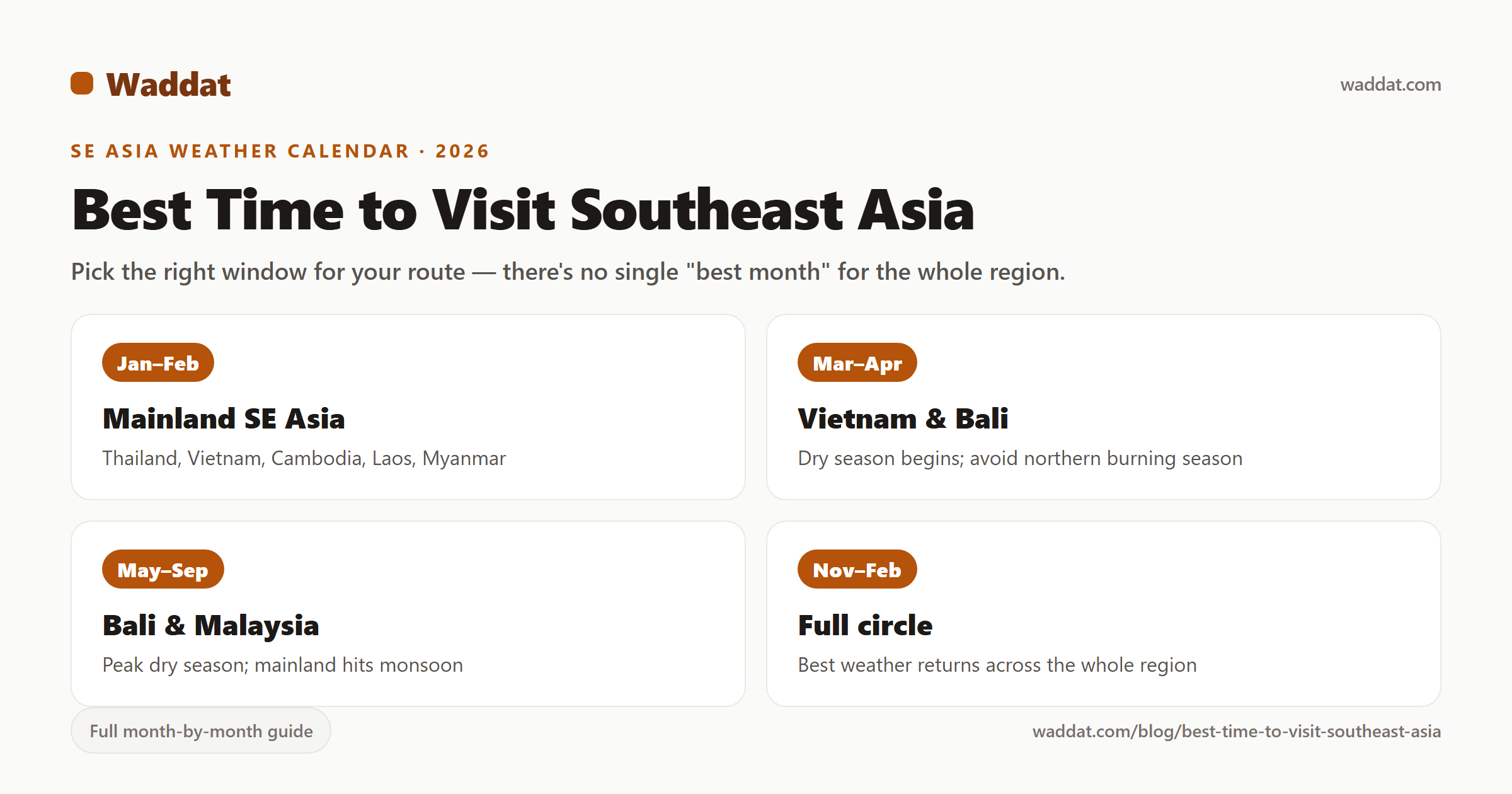
These visuals are free to reuse in your own articles, round-ups and social posts — just keep the page URL that's baked into each image. Perfect for Pinterest, Instagram and travel-planning round-ups.
🗓️ Downloadable Colour-Coded Heatmap
The matrix above as a clean, colour-coded PNG (green = best, amber = good, red = avoid). Drop it straight into a blog post.
🌏 Overview Share Card (1200×630)
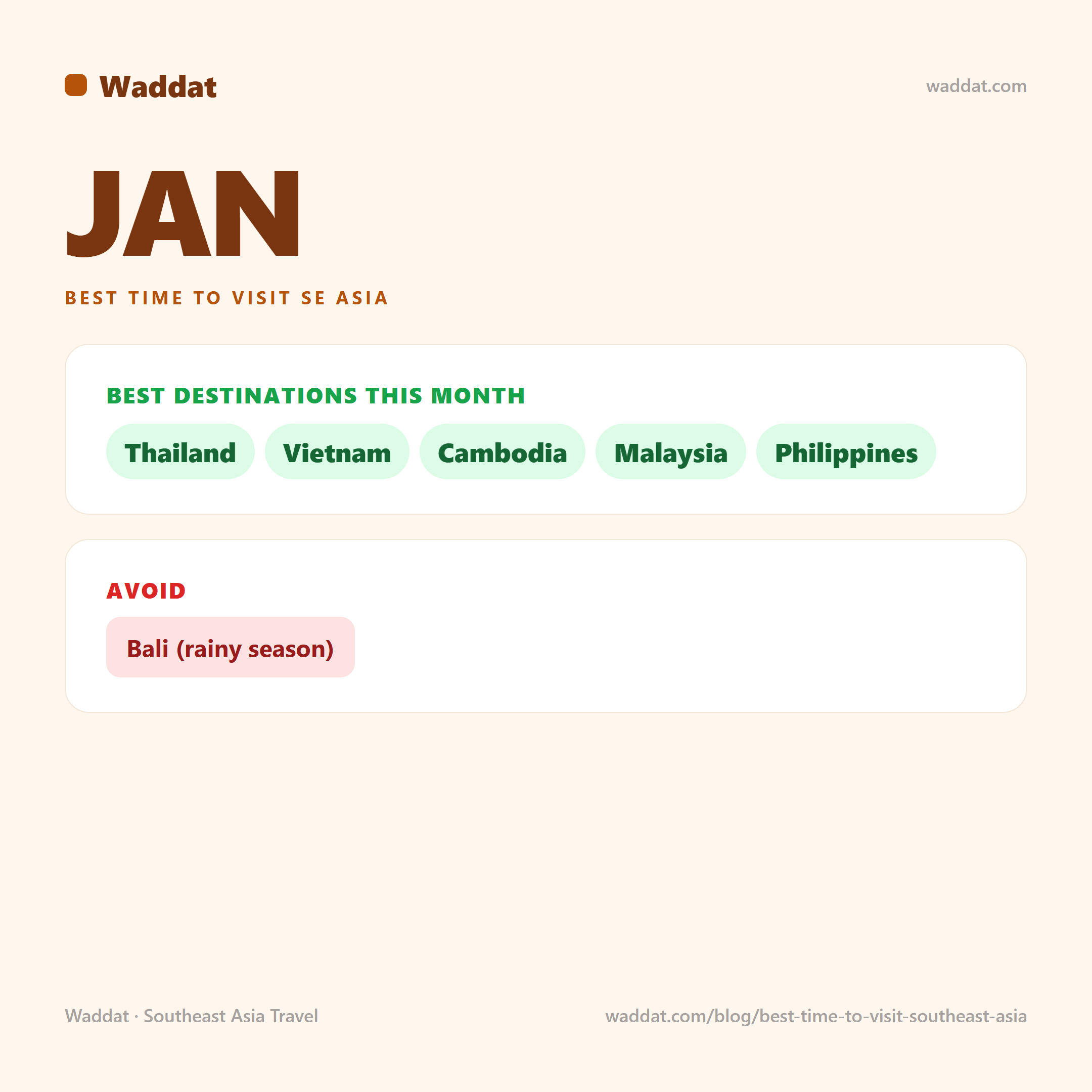
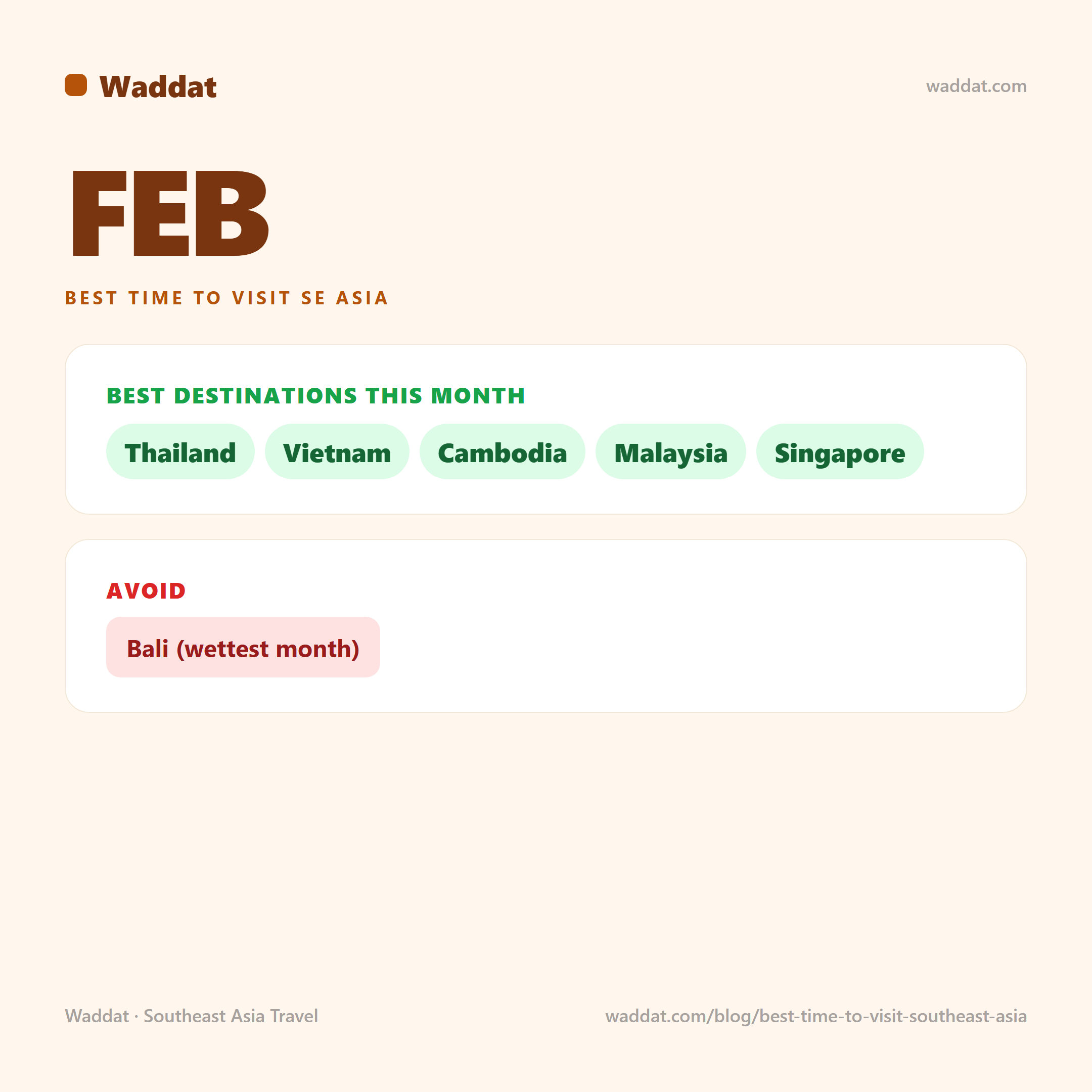
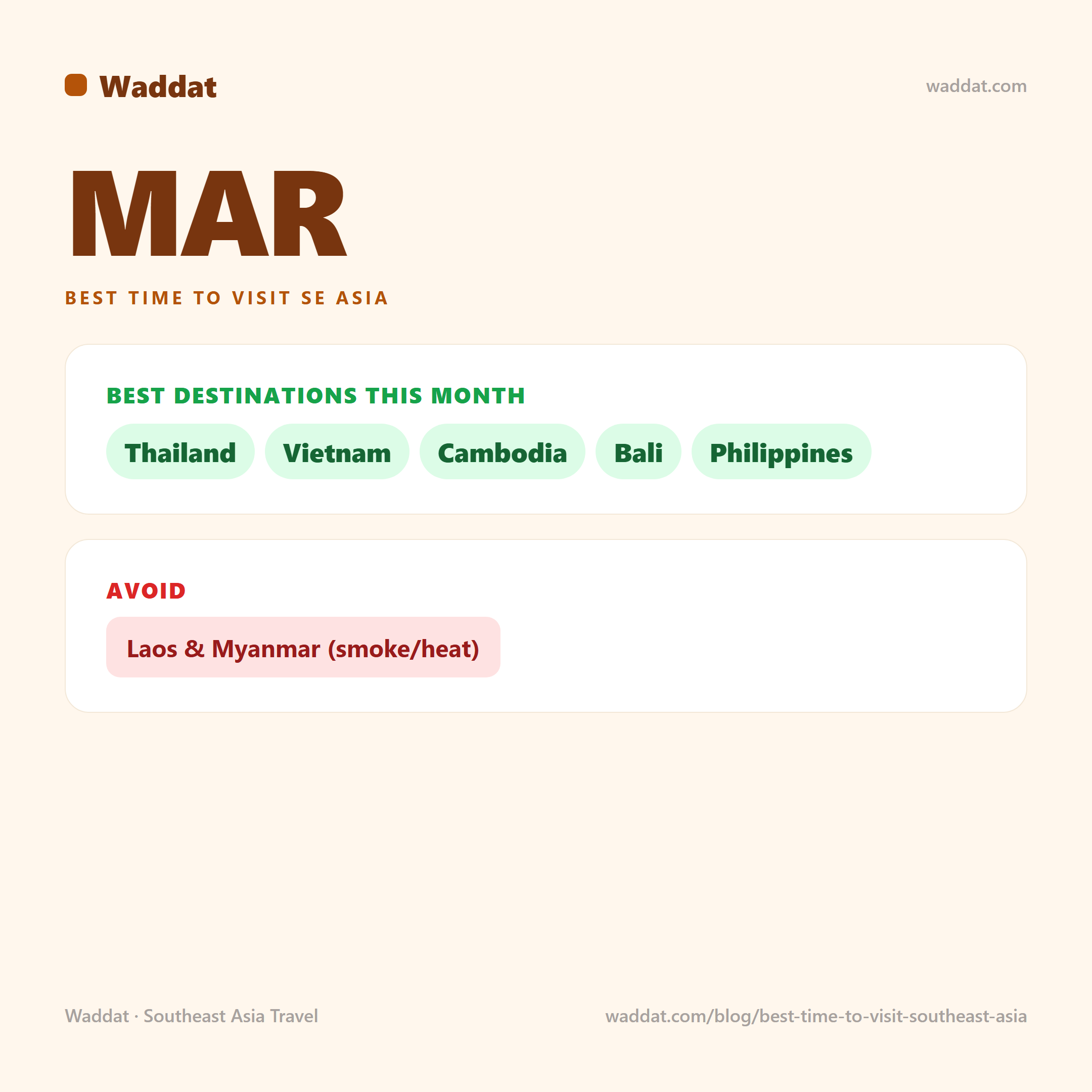
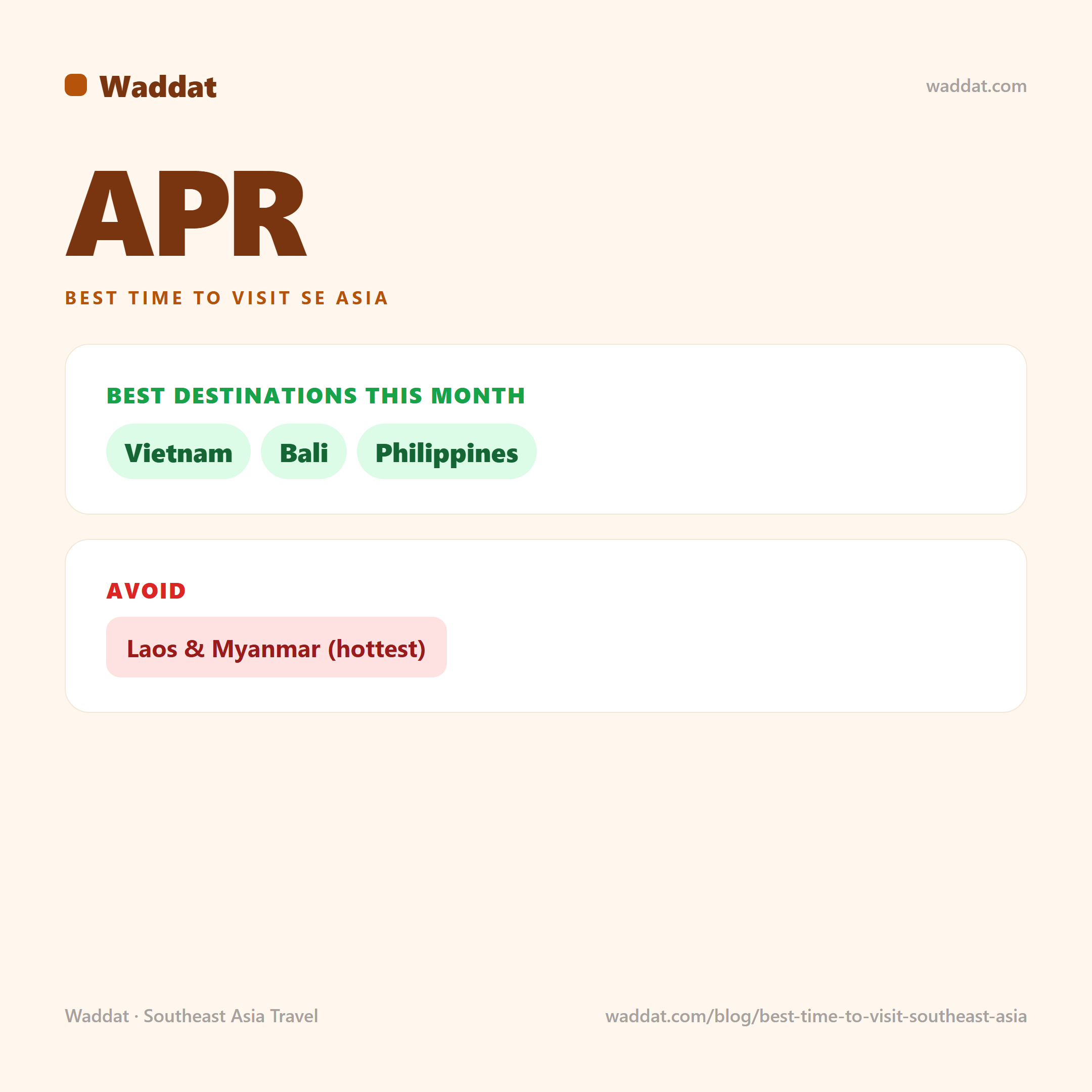
📅 Month-by-Month Square Cards (1080×1080 — Pinterest & Instagram)
One square card per month — the best destinations to visit and what to avoid. Save and share individually.
📋 Cite This Calendar
The best time to visit SE Asia, month by month ([Waddat, 2026](https://www.waddat.com/blog/best-time-to-visit-southeast-asia/)).
SE Asia Festival Calendar 2026
Timing your trip around a festival can be a highlight — or a headache if you don't plan ahead. Here are the major festivals across SE Asia in 2026:
| Month | Festival | Country | What to Expect |
|---|---|---|---|
| January | Tet (Lunar New Year prep) | Vietnam | Travel bookings spike; start planning early |
| February | Tet (Lunar New Year, ~Feb 17) | Vietnam | Country shuts down for 5–7 days. Hotels book out weeks ahead. Incredible if you plan early. |
| February | Chinese New Year | Malaysia, Singapore | Chinatowns come alive. Singapore's celebrations are spectacular. Accommodation gets expensive. |
| March | Bali Spirit Festival | Bali (Ubud) | Yoga, music, and wellness festival. Ubud gets busy — book early. |
| March | Thingyan (Water Festival) | Myanmar | Myanmar's New Year. Massive water fights. Fun but wet. |
| April | Songkran (Water Festival, Apr 13–15) | Thailand | The world's biggest water fight. Bangkok and Chiang Mai are epic. Book hotels months ahead. |
| April | Pi Mai Lao (New Year, Apr 14–16) | Laos | Water fights in Luang Prabang, temple ceremonies, beauty pageants. |
| April | Khmer New Year (Apr 14–16) | Cambodia | Siem Reap celebrations with traditional games and temple visits. Phnom Penh empties as locals go home. |
| May | Vesak (Buddha Day) | All Buddhist countries | Temple celebrations, lanterns, processions. Particularly beautiful in Borobudur (Java) and Yangon. |
| June | Bali Arts Festival | Bali | Month-long cultural festival in Denpasar. Dance, music, art. |
| July | Asalha Puja / Khao Phansa | Thailand, Laos, Cambodia | Buddhist Lent begins. Monks retreat to temples. Alms-giving ceremonies. |
| August | Independence Day | Indonesia (Aug 17) | Flag ceremonies, cultural events. Bali hotels fill up with domestic tourists. |
| September | Mid-Autumn Festival | Vietnam | Lanterns, mooncakes, lion dances. Hoi An is magical during this time. |
| October | Pha That Luang Festival | Laos (Vientiane) | Massive religious festival at Laos's golden stupa. Hundreds of monks, fireworks, fairs. |
| October | Bon Om Touk (Water Festival) | Cambodia | Boat races on the Tonle Sap river in Phnom Penh. Huge crowds. |
| November | Loy Krathong / Yi Peng (Nov 5–6) | Thailand, Laos | Floating lanterns and sky lanterns. Chiang Mai's Yi Peng is iconic. Book 3+ months ahead. |
| November | Borneo International Kite Festival | Malaysia (Borneo) | Colourful kite displays in Kota Kinabalu. |
| December | Christmas & New Year | Philippines, Singapore | The Philippines has the world's longest Christmas season (September to January!). Singapore's Orchard Road light-up is stunning. |
Planning tip: If you're traveling during Songkran (April), Tet (February), or Loy Krathong (November), book accommodation at least 2–3 months ahead. These are the busiest times of the year and hotels fill up fast.
Best Multi-Country Itineraries by Month
January–February: Classic SE Asia
Route: Thailand → Cambodia → Vietnam All three are in their dry season. The most popular time for a reason.
March–April: Mainland + Bali Combo
Route: Vietnam → Thailand → Bali Vietnam and Thailand are still dry (getting hot). Bali is entering its dry season. Perfect timing for a combined trip.
May–June: Island Hopping
Route: Bali → Lombok → Gili Islands → Philippines Mainland SE Asia is wet, but the islands are great. Bali is peak dry season. Philippines is still in its dry season.
July–August: Summer Escape
Route: Bali → Malaysia → Singapore Bali and Malaysia are at their best. The Gulf of Thailand (Koh Samui, Koh Phangan) is also good during these months.
September–October: Value Season
Route: Vietnam (south) → Cambodia → Laos Prices are low, crowds are thin. Vietnam's south and Cambodia are transitioning out of the rainy season. Bali is still great.
November–December: Full Circle
Route: Myanmar → Laos → Thailand → Cambodia → Vietnam The dry season returns to mainland SE Asia. Start in Myanmar and work your way east.
Read more: 1-Month SE Asia Itinerary | 2-Week SE Asia Itinerary | SE Asia Travel Cost Guide | SE Asia Visa Requirements
Packing Tips by Season
Before you pack, check deals on flights and hotels: Booking.com for accommodation, 12Go.asia for buses and trains, and Klook for tours and activities.
Dry Season (Nov–Apr mainland, Apr–Oct Bali)
- Light, breathable clothing
- Sunscreen (SPF 50+)
- Hat and sunglasses
- Light rain jacket (just in case)
- Comfortable walking shoes
- Modest clothing for temples (cover shoulders and knees)
Rainy Season (May–Oct mainland, Nov–Mar Bali)
- Quick-dry clothing
- Waterproof rain jacket or poncho
- Dry bags for electronics and documents
- Waterproof sandals
- Insect repellent (mosquitoes are worse)
- Umbrella
- Flip-flops for flooded streets
Hot Season (Mar–May mainland)
- Cooling towel
- Multiple changes of clothes (you'll sweat through them)
- Electrolyte packets
- Portable fan
- Light, loose-fitting clothing
Frequently Asked Questions
What is the overall best month to visit Southeast Asia?
January and February are the safest bets for the broadest range of destinations. Mainland SE Asia is in its cool, dry season. Bali is in the wet season but still very travelable.
Is the rainy season really that bad?
Not as bad as people think. Rain usually falls in heavy afternoon or evening bursts, lasting 1–3 hours. Mornings are often sunny. The main downsides: higher humidity, occasional flooding, and rough seas for boat trips. Plus, you'll save 30–50% on accommodation.
Can I visit SE Asia in summer (June–August)?
Yes, but you need to be strategic. Bali, Malaysia, and Singapore are excellent in summer. The Gulf of Thailand (Koh Samui, Koh Phangan) also has good weather. Mainland SE Asia will be rainy.
When is the cheapest time to visit SE Asia?
September–October for mainland SE Asia and January–March for Bali. You'll find the best hotel deals and fewest crowds during these shoulder and low seasons.
Does SE Asia get cold?
Only in northern areas during the cool season. Sapa (Vietnam) and Luang Prabang (Laos) can drop to 10–15°C (50–59°F) in December–January. Most of SE Asia is warm to hot year-round.
When is the worst time to visit SE Asia?
It depends on the region, but generally September is the wettest month across mainland SE Asia, and August–October is typhoon season in the Philippines. Avoid these if you hate rain.
How to Get There
By air: Major entry points include Bangkok (BKK/DMK), Singapore (SIN), Kuala Lumpur (KUL), Ho Chi Minh City (SGN), and Denpasar/Bali (DPS). Budget airlines like AirAsia, Scoot, and VietJet offer cheap regional flights ($30–$80 between cities).
By land: Overland border crossings are common between Thailand, Laos, Cambodia, and Vietnam. Most are straightforward — check current opening status before traveling.
Last updated: April 2026. Weather patterns can vary from year to year due to El Niño/La Niña cycles. Always check current forecasts before traveling.
Explore the Destination
Southeast Asia Travel Guide
Hotels, activities, and travel tips for Southeast Asia
You Might Also Like