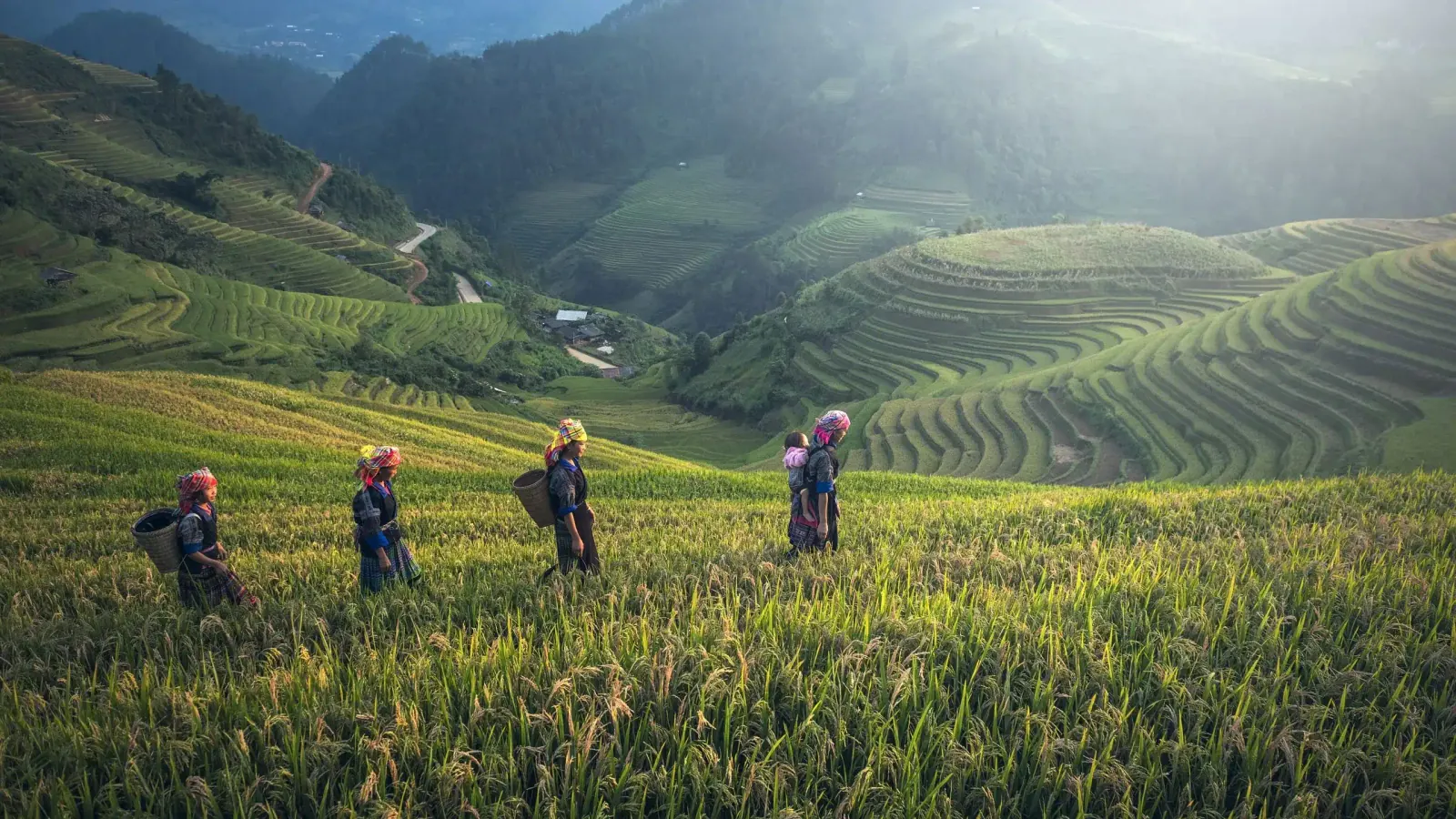
Terraced rice fields, mountain trekking, and ethnic minority culture
Sapa Travel Guide: Rice Terrace Treks, Fansipan and Homestays
Updated
Sapa at a glance
Sapa is a highland town in Lao Cai Province in the far north of Vietnam, sitting at an altitude of approximately 1,600 metres above sea level in the Hoang Lien Son mountain range. The town and its surrounding valleys are among the most visually dramatic landscapes in Southeast Asia, with tiered rice terraces carved into steep slopes, mist-draped mountain peaks, and a patchwork of ethnic minority villages inhabited by the Black Hmong, Red Dao, Tay, Giay, and Xa Pho peoples.
Where is Sapa?
Sapa is in Vietnam, Southeast Asia, about 250 km north-west of Hanoi in a straight line. Its coordinates are 22.3364° N, 103.8438° E.
Sapa quick facts
Best time to visit
September - October (golden harvest) or March - May (spring flowers)
Daily budget
US$30-120 per day
Currency
Vietnamese Dong (VND)
Nearest airport
LCA (Lao Cai, 38km) / HAN (Hanoi, ~320km)
Language
Vietnamese; ethnic minority languages in villages (English in tourist areas)
The landscape takes on different characters across the seasons. September and October are widely considered the finest months to visit, when the rice terraces ripen to a deep gold before harvest, bathing the valley in warm colour. Spring from March to May brings fresh green paddies and wildflowers. Winter from December to February can bring frost and occasional snowfall at the highest elevations, while summer sees lush growth and occasional cloud inversion events where the valleys fill with sea-like mist below the hilltops.
The main draw for most visitors is trekking through the Muong Hoa Valley and its tributary paths, which lead through villages such as Lao Chai, Ta Van, Y Linh Ho, and Ta Phin. Routes range from easy half-day walks to multi-day treks requiring a local guide. Spending a night in a village homestay, eating home-cooked food and participating in daily life, is a highlight for many travellers and provides a meaningful alternative to the town's growing number of hotels.
Fansipan, the highest peak in Indochina at 3,143 metres, rises to the southwest of Sapa. It can be reached either by a challenging two-to-three-day guided trek through dense forest, or in approximately 15 minutes via the Sun World Fansipan Legend cable car, which is listed among the world's longest non-stop cable cars. The summit area has been developed with pagodas and monuments that attract large numbers of Vietnamese pilgrims and tourists.
Sapa town itself has grown rapidly, with an increasing number of hotels, restaurants, and shops catering to both domestic and international visitors. The weekly Sapa market remains a hub for ethnic minority communities who travel in from surrounding valleys. Lao Cai, the nearest sizeable city and railway junction, is 38 km away and connected to Hanoi by overnight train in approximately eight hours.
When to go
When is the best time to visit Sapa?
Perched at 1,500 m in the Hoang Lien Son mountains, Sapa is misty, cool and seasonal in a way the rest of Vietnam isn't. The golden rice harvest (September-October) and spring bloom (March-May) are the two peak windows - staggeringly beautiful, though busy. Winter can drop near freezing with rare snow on Fansipan.
Sep-OctGolden harvest - the rice terraces turn amber and the whole region glows. The most photogenic time; book homestays months ahead.
Mar-MaySpring bloom - plum and peach blossoms, planting season and clear days for Fansipan. Cooler than the lowlands.
Jun-AugGreen season - vivid green terraces under rain and mist. Warm and lush but visibility on Fansipan is hit-and-miss.
Nov-FebWinter - cold (5-15 °C, occasionally sub-zero), with frost and rare snow on the peaks. Quietest, cheapest, bring a warm jacket.
Attractions
Things to Do in Sapa
Sapa is all about the mountains - rice-terrace treks into Hmong and Dao villages, the cable car up Indochina's highest peak, and hill-tribe culture unchanged for centuries. Two or three days is ideal; combine with Hanoi and Ha Long Bay for the classic northern loop.
Fansipan (“the Roof of Indochina”)
At 3,143 m, Fansipan is the highest peak in Vietnam, Laos and Cambodia. The three-cable-car ride (a Guinness record) whisks you near the summit in 15 minutes; from there climb 600 steps past pagodas to the top, or tackle the two-day trek for the full adventure. Wrap up - it's cold and misty up high.
Cable car ~780,000 VND ($31) round trip; open daily weather permitting.
Trek to Cat Cat & Lao Chai Villages
The signature Sapa experience - hike down through terraced valleys into Black Hmong villages, past waterfalls and rice paddies. Cat Cat is an easy half-day; Lao Chai and Ta Van are longer, deeper routes with homestays. Hire a local Hmong guide for context and to support the community.
Guided day treks from ~300,000 VND ($12); homestays ~250,000 VND ($10)/night.
Muong Hoa Valley & the Ancient Carved Stones
The valley between Sapa and the villages holds hundreds of mysterious ancient sandstone boulders carved with motifs, spirals and figures - a UNESCO-listed archaeological site of unknown origin. Best seen on a guided valley trek; the scenery alone is worth the walk.
Sapa Market & Hill-Tribe Culture
The town's central market and the weekly Bac Ha market (Sunday) are where the Flower Hmong, Red Dao and Tay come to trade in vivid indigo and embroidered dress. Great for handicrafts, textiles and watching traditional life. Buy directly from the makers and bargain kindly.
Silver Waterfall & Heaven's Gate Pass
A short ride from town, the 200-m Thac Bac (Silver) Waterfall tumbles down the mountainside, and the nearby Tram Ton (Heaven's Gate) pass is Vietnam's highest road - with sweeping views over the valley below. An easy half-day circuit by motorbike or car.
Ham Rong Mountain Gardens
Flower terraces, stone figurines and a Hmong cultural show on a hillside right above Sapa town - a gentle, family-friendly climb with views back over the rooftops and to Fansipan. A good rainy-day or easy-afternoon option.
Transport
How to Get to & Around Sapa
Sapa has no airport - most travellers arrive by overnight train or new expressway from Hanoi. The town itself is small and walkable; for the valleys and villages you'll trek, ride or hire a driver.
Express train + busThe classic Hanoi-Lao Cai overnight train (8 hrs) plus a 1-hr minibus up to Sapa. Berths from ~700,000 VND ($28); book a reputable line (Victoria, Livitrans).
Expressway bus / limousineNew Hanoi-Lao Cai expressway means a 5-hr sleeper or limousine van direct to Sapa from ~300,000 VND ($12). Cheaper and faster than the train.
MotorbikeThe adventurous ride up from Hanoi (or the Ha Giang loop from the north). Only for experienced riders - mountain roads, fog and trucks.
TrekkingHow you see the valleys - half- and full-day guided hikes to the villages, with homestays for multi-day routes.
Taxi & motorbike taxiFor Fansipan station, waterfalls and the pass - Grab cars and xe om from ~50,000 VND ($2) for short hops.
Sapa is the crown of the northern loop - pair it with Hanoi, the karsts of Ha Long Bay, and the central coast of Da Nang.
Accommodation
Where to Stay in Sapa
Stay in town for convenience, or out in the valleys for the full rice-terrace immersion. Book early in harvest season - Sapa fills up and the best homestays go fast.
Sapa town centre - best for convenience
Hotels, hostels and eateries clustered around the lake and church - walk to the market, Fansipan station and trek start points. The practical base for short stays.
Valley homestays (Lao Chai, Ta Van) - best for immersion
Sleep in a Hmong or Dao family home among the rice terraces - simple dorm mattresses or private rooms, home-cooked dinners, sunrise over the paddies. The real Sapa experience.
Hillside resorts - best for views & luxury
Boutique mountain lodges and villas perched above the valley with floor-to-ceiling terrace views, fireplaces and spas. The splurge for honeymooners and Fansipan sunrise chasers.
Backpacker hostels - best for budget
Cheap social dorms in town - trekking buddies, beer and travel info. From ~150,000 VND ($6)/night.
Food & drink
What & Where to Eat in Sapa
Sapa's cool mountain climate shapes a heartier, more northerly cuisine - think hotpots, grilled meats on bamboo, and foraged herbs. It's comfort food after a cold, misty trek.
Thang co - the traditional Hmong horse-meat (now often beef) hotpot stewed with herbs, served at markets. Cap nach pork - tiny mountain-raised pigs grilled over charcoal, a regional specialty. Black chicken hotpot - free-range black-boned chicken in a fragrant broth with greens.
Vegetarians will find mushroom hotpots, tofu and mountain-vegetable dishes - ask at homestays and they'll happily cook for you.
Sapa Market food courtGrilled skewers, thang co and pho at local prices - the authentic hill-town feed.
Grilled-corn & sweet-potato stallsCharcoal grills around the lake on cold evenings - the perfect post-trek snack.
Homestay dinnersFamily-style spreads of mountain dishes - often the best meal you'll have in Sapa.
Plan your trip
Practical Tips & Budget
UK and most EU passports get 45 days visa-free; US, Australian and Canadian passports need an e-visa ($25, up to 90 days, as of November 2026) - see our Vietnam visa guide. The currency is the Vietnamese dong (VND). English is spoken in hotels and by many guides. Sapa is cold - pack warm layers, waterproofs and sturdy trekking shoes no matter the season.
How much does Sapa cost?
Budget$20-35/day - hostel dorm, market meals, a guided village trek and a bus from Hanoi.
Mid-range$50-90/day - a valley homestay or boutique, the Fansipan cable car and a two-day guided trek.
Luxury$120+/day - a mountaintop villa, private guiding and the overnight train berth.
Good to know
Book the train early: Hanoi-Lao Cai berths sell out, especially at weekends and harvest time.
Responsible trekking: Use licensed local guides and buy handicrafts directly from makers - it's their livelihood.
Altitude: Sapa town is ~1,500 m; Fansipan 3,143 m. Pace yourself if you're trekking up.
Photos: Always ask before photographing hill-tribe people; some expect a small tip or sale.
Weather changes fast: Fog can erase Fansipan views in minutes - check conditions before paying for the cable car.
A five-star Accor MGallery property in the heart of Sapa town, designed in a French Indochina style that evokes the town's colonial heritage with a contemporary interpretation. The hotel features a heated indoor pool, a full-service spa, multiple restaurants, and panoramic valley views from its elevated position on the town's main ridge.
$$$
· Sapa Town Edge
Silk Path Grand Sapa Resort & Spa
A five-star resort on the edge of Sapa town with elegant rooms offering valley and mountain views, a heated indoor pool, a spa, and multiple restaurants. The resort is a well-regarded luxury choice for visitors who want high-end facilities alongside easy access to the town's shops and trekking departure points.
$$$
· Sapa Outskirts
Lady Hill Sapa Resort
A five-star hilltop resort on the outskirts of Sapa, featuring bungalow-style accommodations set into the hillside with panoramic views over the valley and rice terraces. The property prioritises tranquillity and natural surroundings while offering a full range of resort amenities.
$$$
See all 5 luxury hotelsShow fewer luxury hotels
· Cat Cat Village
Sapa CatCat Hills Resort & Spa
A four-star resort perched above Cat Cat Village with terraced gardens, infinity pool overlooking the valley, spa facilities, and comfortable rooms with mountain views. The resort's position between town and the village trail makes it a practical base for both sightseeing and trekking.
$$$
· Sapa Outskirts
Sapa Jade Hill Resort & Spa
A four-star resort outside Sapa town set on a hillside with terraced gardens and far-reaching valley views. The resort includes a spa, outdoor pool, and spacious rooms and villas with private balconies. A quieter option suited to couples and honeymoon travellers.
$$
Boutique
· Hoang Lien National Park
Topas Ecolodge
A celebrated eco-retreat set on a remote hilltop within Hoang Lien National Park, about 45 minutes from Sapa town, featuring 50 white granite bungalows with panoramic views of the Muong Hoa Valley. Recognised by National Geographic and Conde Nast Traveler, the lodge is committed to sustainable tourism and is the benchmark eco-accommodation in northern Vietnam.
$$$
· Sapa Town Centre
ALIANA Boutique Sapa Hotel & Spa
A four-and-a-half-star boutique hotel in Sapa town with chic, well-designed rooms, a heated pool, a spa, and strong mountain views. The hotel consistently receives high guest reviews for service quality and the warmth of its staff, making it a reliable mid-to-upper choice in the town centre.
$$
See all 4 boutique hotelsShow fewer boutique hotels
· Sapa Town Centre
DeLaSol Sapa Central Boutique Hotel
A four-star boutique hotel in central Sapa with contemporary rooms, valley views, a rooftop bar, and a welcoming atmosphere suited to independent travellers. Conveniently located near the town's main restaurants and the starting point for Cat Cat Village walks.
$$
· Muong Hoa Valley Edge
Laxsik Ecolodge
A four-star eco-lodge on the outskirts of Sapa set within rice terrace scenery, offering bungalow-style rooms with wooden decor and valley views. The lodge is committed to sustainable practices and is a good base for trekking into the surrounding villages without going as far as Topas.
$$
Mid-range
· Sapa Town Centre
Pistachio Hotel Sapa
A four-star hotel in Sapa town offering comfortable mountain-view rooms, a rooftop restaurant, a spa, and a central location convenient for the market and tour departures. Known for its helpful staff and good breakfast, it is a popular choice among repeat visitors.
$$
· Sapa Town Centre
Sapa Relax Hotel & Spa
A four-star hotel in the heart of Sapa town with comfortable rooms, a spa offering traditional herbal baths and massage, and a highly rated breakfast. The central location and consistently high guest scores make it one of the best mid-range hotels in town for independent travellers.
$$
See all 4 mid-range hotelsShow fewer mid-range hotels
· Sapa Town Centre
Viettrekking Sapa
A four-star hotel specialising in trekking tourism, with knowledgeable staff who organise guided treks, homestay bookings, and cultural tours for guests. The hotel's combination of comfortable accommodation and integrated trekking services makes it a practical one-stop base for active visitors.
$$
· Sapa Town Centre
Sapa Freesia Hotel
A four-star hotel in Sapa town offering valley-view rooms, a rooftop pool, and a spa at competitive rates. The hotel is especially popular with domestic travellers and offers a well-rounded set of facilities without the premium price of the top luxury properties.
$$
Budget
· Sapa Town Centre
Sapa Horizon Hotel
A four-star hotel in central Sapa with clean, well-equipped rooms and valley views, a small spa, and a restaurant serving both Vietnamese and international dishes. Consistently reviewed well for value, it is a reliable mid-range option for travellers not wanting to splurge on the top properties.
$
· Muong Hoa Valley
Sapa Pine Hill Ecolodge
A three-star eco-lodge set a five-minute walk from Muong Hoa Valley, offering timber-and-stone bungalows surrounded by pine trees and rice fields. Simple but charming, the lodge is positioned for easy access to trekking routes and is an affordable alternative to Topas for eco-conscious travellers.
$
See all 4 budget hotelsShow fewer budget hotels
· Sapa Town Centre
Sapa Diamond Hotel
A three-and-a-half-star hotel in Sapa town offering clean rooms, mountain views from the upper floors, a spa, and affordable rates that appeal to budget travellers who want a comfortable base without the cost of four or five-star properties.
$
· Sapa Town Centre
KK Sapa Hotel
A popular budget hotel in the centre of Sapa offering good value rooms with mountain views, an in-house restaurant, and approachable rates for backpackers and independent travellers. The hotel has developed a loyal following for its friendly service and helpful trek arrangement assistance.
$
Tours and day trips in Sapa
Nature · Half day
Fansipan Summit via Sun World Cable Car
A scenic cable car ride on the Sun World Fansipan Legend cable car - one of the world's longest non-stop cable cars at 6.3 km - ascending to near the summit of Fansipan at 3,143 metres, the highest peak in Indochina. At the top, a series of Buddhist pagodas and the iconic summit marker await, with panoramic views across the Hoang Lien Son range on clear days.
$$
Adventure · 2-3 days
Fansipan Peak Multi-Day Trekking Challenge
A two-to-three-day guided trek to the summit of Fansipan through dense primary forest and alpine meadows in Hoang Lien National Park. The route requires a permit and an experienced guide, and involves camping overnight on the mountain. A serious achievement for fit trekkers.
$$$
Adventure · Full day
Muong Hoa Valley Trek to Lao Chai and Ta Van
A guided half or full-day trek through the terraced rice fields of the Muong Hoa Valley, visiting the Black Hmong village of Lao Chai and the Giay village of Ta Van. The route follows paths through paddy fields and bamboo groves with a local guide who can communicate with village residents and share cultural context.
$$
Culture · 1-2 nights
Overnight Homestay in an Ethnic Village
A one or two-night stay in a traditional wooden home in a Black Hmong or Red Dao village outside Sapa, sharing meals with a local family, learning about traditional weaving and dyeing techniques, and sleeping on elevated platform beds. One of the most authentic and memorable experiences available in northern Vietnam.
$
Culture · 2-3 hours
Cat Cat Village Walk
A self-guided or guided walk from Sapa town down to Cat Cat Village, a Black Hmong settlement 15 minutes from town that is known for its traditional weaving demonstrations, a modest waterfall, and well-preserved examples of local architecture. The most accessible village from town and a good introduction to the area.
$
Wellness · Half day
Ta Phin Village and Red Dao Herbal Bath
A guided excursion to Ta Phin, a predominantly Red Dao village about 12 km from Sapa, followed by a traditional herbal bath prepared using mountain plants gathered by the village women. The bath is reputed to be deeply relaxing and medicinal, and is a distinctive cultural wellness experience.
$
See all 12 toursShow fewer tours
Culture · 2-3 hours
Sapa Market and Town Exploration
A self-guided or guided exploration of Sapa town's weekly markets, where ethnic minority groups from surrounding valleys gather to trade goods, textiles, and produce. The Saturday night Love Market, where young people from different communities meet and socialise, is a particularly lively event.
Free
Nature · 3-4 hours
Rice Terrace Photography Tour at Sunrise
An early morning photography outing led by a local guide to the most photogenic terrace viewpoints in the Muong Hoa Valley, timed to catch the mist rising over the fields at first light. Particularly rewarding in September and October when the paddies are heavy with golden grain.
$
Adventure · Full day
Mountain Biking Through Sapa Valley
A guided mountain bike ride from Sapa town into the surrounding valleys, cycling through rice terrace paths, crossing bamboo bridges, and visiting villages. Topas Ecolodge and several operators in town offer guided bike routes suitable for various fitness levels.
$$
Culture · 2-3 hours
Hmong Textile Weaving Workshop
An interactive workshop in Sapa town or a nearby village where local Black Hmong women teach visitors to embroider and weave using traditional patterns and natural indigo dye. Participants can take home a small piece of hand-crafted fabric as a souvenir.
$
Nature · Full day
Hoang Lien National Park Nature Walk
A guided walk inside Hoang Lien National Park, a biodiversity hotspot in the Hoang Lien Son range that is home to numerous endemic plant and bird species. The park protects a range of forest types from tropical lowland to montane cloud forest, offering excellent birdwatching for keen naturalists.
$$
Nature · Half day
Silver Waterfall and Love Waterfall Day Trip
A day trip from Sapa to the Silver Waterfall (Thac Bac), one of the most impressive cascades in the region at around 100 metres high, followed by a walk through pine forest to the Love Waterfall - a smaller but romantically positioned cascade popular with Vietnamese couples.
$
Sapa travel FAQ
What is the best time to visit Sapa?
September and October are the most popular months, when the rice terraces turn gold before harvest and the weather is clear and cool. Spring from March to May offers fresh green scenery and blooming flowers in Muong Hoa Valley. Summer is lush but can be wet and misty. Winter from December to February is cold - occasionally below freezing at high altitude - but also offers dramatic atmosphere and occasional snowfall.
How do I get to Sapa from Hanoi?
The most popular route is the overnight train from Hanoi to Lao Cai (approximately 8 hours), followed by a 38 km bus or taxi transfer to Sapa town. Several train companies operate on this route with various cabin grades. Alternatively, direct sleeper buses run from Hanoi to Sapa in around 5-6 hours. Lao Cai also has a small domestic airport (LCA) with limited flight connections.
Do I need a guide to trek in Sapa?
A local guide is strongly recommended for village treks, particularly for multi-day routes, as trails are not always well-marked and the insight provided by a guide from one of the local ethnic communities adds significant depth to the experience. Many guides are Black Hmong or Red Dao women who grew up in the villages you visit. For the Fansipan cable car, no guide is required.
What is the Fansipan cable car experience like?
The Sun World Fansipan Legend cable car departs from a station near Sapa town and travels approximately 6.3 km to a point near the Fansipan summit at 3,143 metres in around 15 minutes. The views over the valleys and ridgelines are spectacular on clear days. At the top, a series of steps lead to pagodas and the summit marker. Temperatures at the top can be significantly colder than in town.
What are ethnic minority homestays in Sapa like?
Village homestays in communities such as Ta Van, Lao Chai, and Ta Phin typically involve sleeping in a simple wooden house on raised platforms with mattresses and quilts provided. Meals are cooked by the host family and feature local ingredients. The experience is immersive, affordable, and widely regarded as one of the most authentic ways to experience Sapa's highland culture.
Is Sapa worth visiting without trekking?
Yes. Visitors who prefer not to trek can still enjoy the rice terrace scenery by road, take the Fansipan cable car, visit Cat Cat Village on foot from town, explore the Sapa market, visit the Red Dao village of Ta Phin, and enjoy the town's growing restaurant and café scene. The mountain landscape is rewarding even from a hotel terrace on a clear morning.
What should I pack for a Sapa trip?
Regardless of the season, pack warm layers as temperatures drop significantly after dark and during misty periods. Waterproof or quick-drying clothing is advisable, along with good walking shoes or light trekking boots for village paths. Sun protection is important on clear summit days. A small daypack for trek snacks and water is useful.
Do I need a visa to visit Vietnam?
UK citizens and citizens of 18 EU states (including Germany, France, Italy, Spain and the Netherlands) get 45 days visa-free, as do Japanese and South Korean citizens. US, Australian and Canadian passport holders need an e-visa from the official portal (evisa.gov.vn): USD 25 for a single entry of up to 90 days, with 3 to 5 working days processing. See the Waddat Southeast Asia visa guide for the full list and official links.
Is Sapa safe for tourists?
Sapa is safe from a crime point of view; the risks come from the mountains. Trails through Muong Hoa Valley turn muddy and slippery after rain, fog can roll in quickly, and Fansipan at 3,143 m gets cold even in summer. Trek with a licensed local guide, wear proper shoes and carry layers. Expect persistent handicraft sellers to walk alongside you - a polite, firm no is enough.
How many days do you need in Sapa?
Two to three days is ideal. Spend one day on the Fansipan cable car and the town's market and Ham Rong gardens. Use a second for a guided trek through Muong Hoa Valley to Lao Chai, past the ancient carved stones, ideally with a homestay night. A third day suits Cat Cat village, Silver Waterfall and Heaven's Gate Pass. Allow extra time for the journey from Hanoi.
How do you get from Lao Cai station to Sapa?
Overnight trains from Hanoi arrive at Lao Cai station, about 38 km below Sapa. Minibuses and shared vans wait outside to meet the trains and climb to Sapa town in about an hour; private cars and pre-booked hotel transfers are also available. Direct sleeper and limousine buses from Hanoi skip Lao Cai entirely.
How do you get around Sapa?
Sapa town is small and walkable, though steep. The valleys and villages are reached on foot: half-day and full-day guided treks run to Cat Cat, Lao Chai and Ta Van, with homestays on longer routes. For Fansipan's cable car station, Silver Waterfall and Heaven's Gate Pass, use Grab cars or motorbike taxis. Only experienced riders should rent a scooter, given the fog, mountain bends and trucks.